What DTF demands from a press
Applying DTF needs three things at once: a real, stable 130 °C across the whole surface, uniform medium-firm pressure for 8 seconds, and a base that doesn't give. Any press that meets that — brand aside — will apply a transfer well.
The problem is that many lie: thermostats that swing ±20 °C, elements that heat the centre and leave the corners cold, or frames that flex under pressure. The transfer registers all of it: corners that don't anchor, over-pressed shiny patches, durability halved.
Will a household clothes iron do?
To get by with small pieces, yes — with technique: NEVER any steam, at about 130 °C, pressing hard with your body weight on a hard surface (a table with a board, not the padded ironing board), 8 seconds per zone and peeling the film instantly, while hot.
Its limits are clear: there's no real control of temperature or pressure, and on designs larger than 15-20 cm it's almost impossible to apply evenly. For trying out DTF or the odd emergency it's fine; for producing, it will hold you back.
Tabletop press: the upgrade that pays off
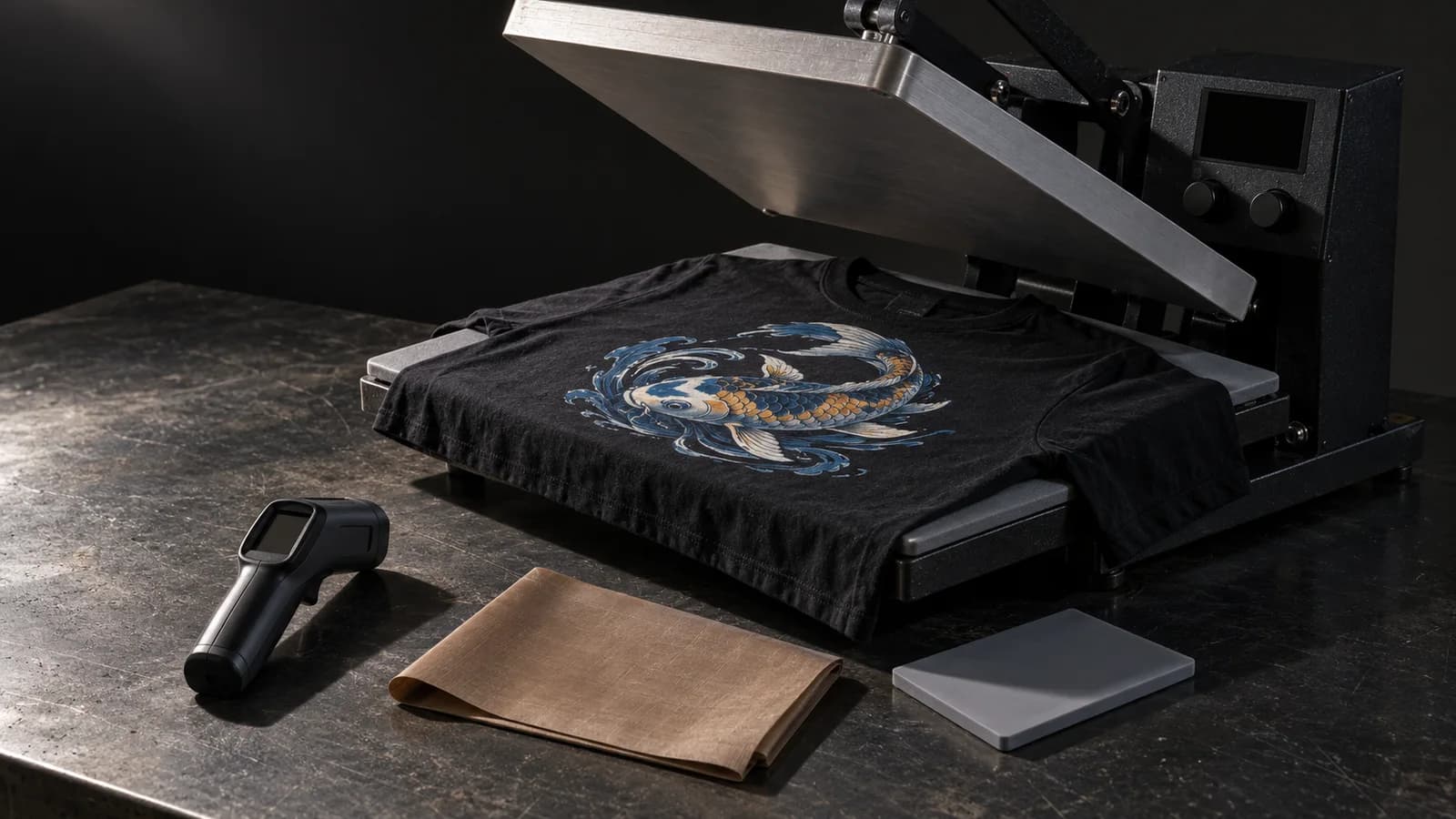
A 38×38 cm clamshell press with a digital thermostat is the entry standard: stable temperature, adjustable pressure and repeatable results from day one. It's the purchase that turns DTF into a process rather than a lottery.
What to look for: verifiable real temperature (a €15 laser thermometer exposes lies), pressure adjustable by screw or a lever that closes firmly, a platen that heats evenly to the edges and a frame that doesn't flex. Decent basic ones start at €150-250; semi-pro models with interchangeable platens, at €300-500.
- 38×38 cm size: covers 90 % of textile jobs.
- Laser thermometer: check the platen before trusting the display.
- Medium-firm pressure = the lever is hard to close, without being impossible.
- A lower platen with the pad in good shape: the base matters too.
When to consider a pneumatic or large-format press
If you press dozens of garments a day, the pneumatic pays for itself: identical pressure on every cycle with no effort from the operator, automatic opening when the time is up and zero variation between garment 1 and 200. It's a production machine, not a starter one.
Large format (40×60, 50×70) only if you print full backs or several pieces per cycle. Beware: the larger the surface, the more even heating matters — on cheap large presses cold corners are an epidemic.
The press mistakes that kill the most transfers
The three classics we see in support: pressing on a padded surface (the foam swallows the pressure), trusting the display without verifying the real temperature, and letting the film cool when it should be peeled instantly, while hot. All three share the same symptom — the transfer peels — and the same fix: method.
Our golden rule for diagnosis: if after removing the film the weave doesn't show faintly through the design, temperature or pressure was lacking. Retry with 10 °C more or half a turn more pressure before blaming the transfer.
- DTF parameters
- 130 °C · 8 s · medium-firm pressure
- Household iron
- Small pieces only, no steam, hard base
- Recommended entry press
- Clamshell 38×38 digital (€150-250)
- Verification
- Laser thermometer on the platen (~€15)
- Daily production
- Pneumatic: identical pressure every cycle
- Correct-application test
- The weave shows through the design