DTF versus cut vinyl
Cut vinyl works well for designs in one or two flat colours and simple text, but it gets complicated with gradients, photographs or several colours, because each layer has to be cut and weeded. DTF prints full colour in a single pass, with no colour limit, and is faster when the design is complex.
For full-colour logos, illustrations or photos, DTF wins on time and result. For a single letter or a large number in one colour, vinyl is still competitive.
DTF versus screen printing
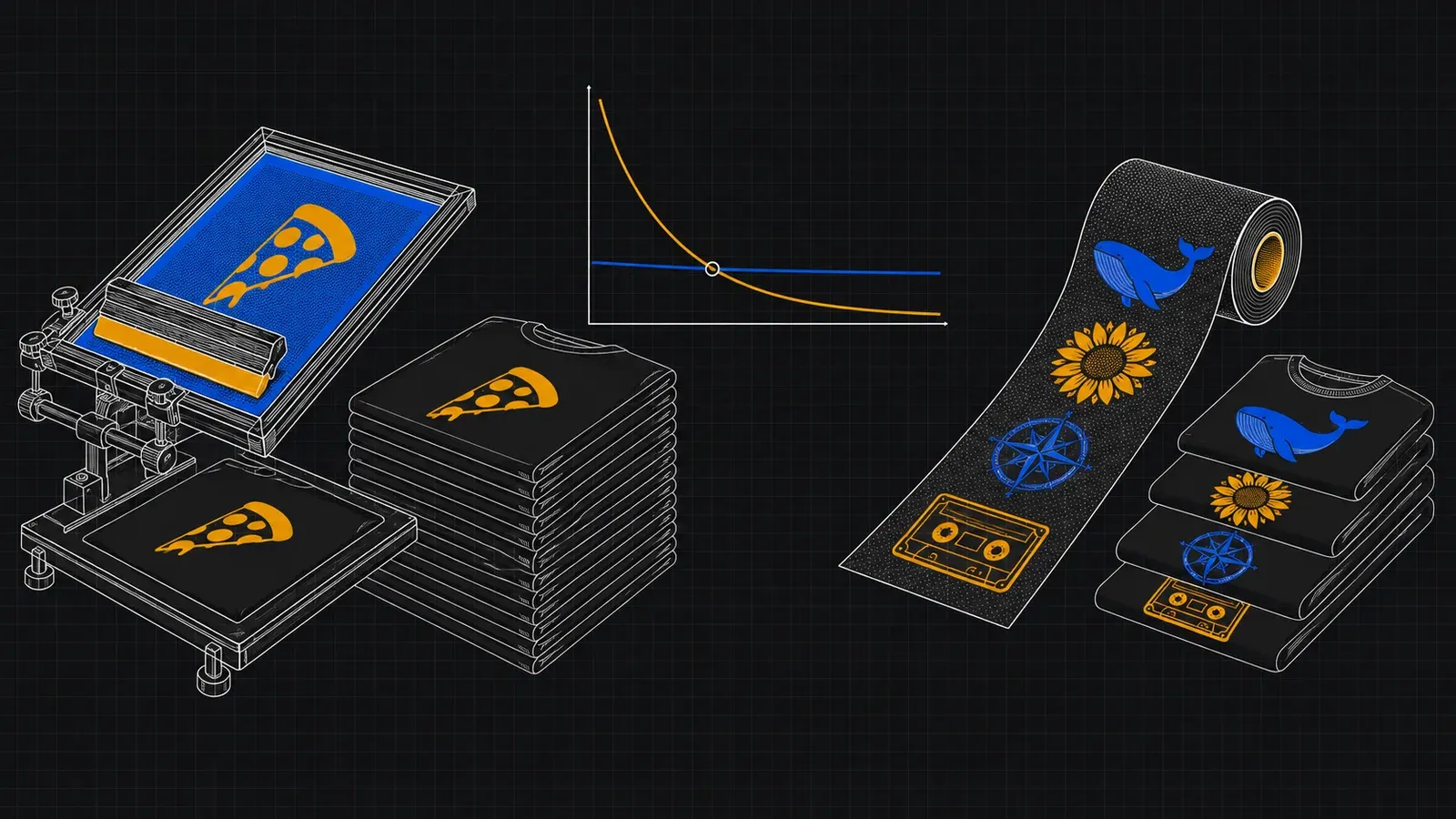
Screen printing is unbeatable on very large runs of the same design with few colours, because the cost per unit drops a lot once the screens are amortised. But it requires preparing one screen per colour and is not cost-effective on small orders or with many different designs.
DTF needs no screens or high minimums: you produce from 1 metre, mix different designs on the same sheet and keep full colour. It is the logical option for brands that produce on demand or without stock.
- Large run, same design, few colours: screen printing.
- Small orders or varied full-colour designs: DTF.
- No investment in screens or machinery: DTF.
DTF versus sublimation
Sublimation gives an excellent feel because the ink integrates into the fibre, but it only works on polyester and light fabrics. You cannot sublimate cotton or dark garments with good results.
DTF applies to cotton, polyester, blends, dark garments and technical fabrics, adjusting temperature and time to the material. If you work with varied fabrics and colours, DTF is far more versatile.
- DTF: colours
- Full colour, no limit
- DTF: fabrics
- Cotton, polyester, blends, darks
- DTF: minimum
- 1 metre or A4/A3 sheet
- Durability
- 50+ washes at 30 °C
- Vinyl
- Better in 1-2 flat colours
- Screen printing
- Better on large runs